
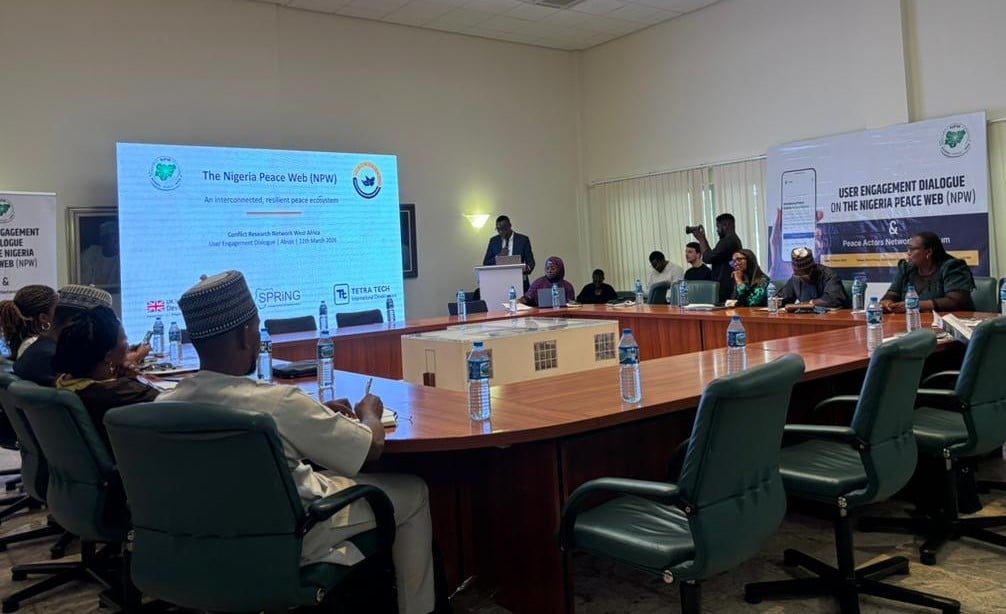
The Conflict Research Network West Africa (CORN), has launched the Nigeria peace web (NPW), a digital platform that aggregates structured data on peace actors, initiatives and peace-related events across the country.
The NPW was initiated under the Nigeria peace actors and initiatives in data (NPAID) project, supported by the strengthening peace and resilience in Nigeria (SPRiNG) programme.
Speaking in Abuja on Wednesday at the unveiling of the platform, Timipere Allison, executive director of CORN West Africa, said Nigeria’s conflict landscape is extensively documented, noting that violent incidents, armed actors and insecurity trends are routinely tracked through national and international monitoring systems.
Represented by Obinna Chukwuezie, an official of CORN West Africa, Allison lamented that the same cannot be said of the peace landscape, adding that “there is no national system that systematically documents who is building peace, where these efforts take place, how they operate, and what lessons they generate”.
“Across the country, community mediators, faith leaders, civil society organisations, traditional authorities, women’s networks, youth groups and state peace agencies work daily to prevent violence and manage tensions,” he said.
“This gap creates a structural imbalance in the evidence base informing peace and security policy. Policymakers, donors and researchers often have detailed visibility of violent events but limited visibility of preventive and peacebuilding activity.”
He noted that policy attention and funding tend to prioritise crisis response over prevention due to the absence of documented peace efforts.
“At the operational level, organisations struggle to identify existing initiatives, potential partners or lessons from past interventions,” he said.
According to Allison, this challenge was confirmed during research conducted with actors within the peacebuilding ecosystem, who said they often rely on personal networks, costly field visits, and fragmented documentation to identify ongoing initiatives.
“Smaller community-led interventions, often the first responder to local tensions, remain largely invisible beyond the immediate contexts,” he said.
“When projects end, documentation is rarely preserved in accessible repositories, resulting in the loss of institutional knowledge.”
Allison said the NPW was developed to address this structural gap, adding that the open-source digital platform “provides a practical response to this long-standing gap. ”.
“Nigeria’s peacebuilding ecosystem is far more extensive than existing policy discussions and media narratives often acknowledge,” he said.
“Across communities, civil society networks and government institutions, actors are continuously mediating disputes, managing tensions and strengthening local resilience. However, much of this work remains poorly documented and weakly connected.
“By aggregating information on peace actors and initiatives into a shared digital platform, NPW establishes a national reference point for understanding how peacebuilding is being practised across Nigeria.
This shift matters because effective peacebuilding depends on cumulative learning. When knowledge from past interventions is preserved and accessible, organisations can build on existing experience rather than repeatedly starting from scratch.
“When actors know who else is working in their geographic or thematic space, collaboration becomes easier and duplication decreases.
“When policymakers and donors can identify areas where preventive initiatives are already demonstrating promise, resources can be directed more strategically.”